
Student-produced news blog
The Spectrum is the online publication of the Urban Journalism Workshop, a career prep program for teens at NYU's Arthur L. Carter Journalism Institute.
Special thanks to the following for their generous support:

Fashion Lifestyle & Culture
Fashioned-stamped in New York City style
By Briana Mirville
The everyday, seen-on-the-street fashionistas of New York are unapologetically themselves.
A woman wearing a flamingo pink tutu sitting over a white formal ball gown on a Tuesday may not be a remarkable occurrence for those used to the city, but for newcomers, it might spark inspiration.
Using their curated clothes to express who they are is important for some. Moving to New York, one of the world’s fashion capitals, has let them evolve more fully their sartorial selves–whether classic or grunge or funky or zany.
The personal style of Breanna Byrd, a 2019 New York University graduate, made a 360-degree pivot when she moved to Manhattan from North Carolina. As she started her first year in college, she took on a business casual style, WEARING WHAT, and taking herself “very seriously.”
But as she continued to settle into the city, she began to notice the diverse ways people dressed. “It was so inspiring to see people play with fashion in New York just casually,” she said, “because it showed me that your clothes don’t have to just be something that you wear to say ‘I’m serious’”
Kaylen Hayes, who currently lives in Atlanta, Georgia, was also exposed to many different styles during her time at NYU from 2015 to 2019. She particularly remembers seeing an uptick in army green bomber jackets and Adidas All-Star shoes. While she tried some of the trends at the time, “in college …we’re all doing a little bit of exploring,” she said she always incorporated her preppier style, whether that be by layering a collared shirt under her cardigan or pairing her t-shirts with slacks.
“I think my favorite thing is feeling like myself,” she said.
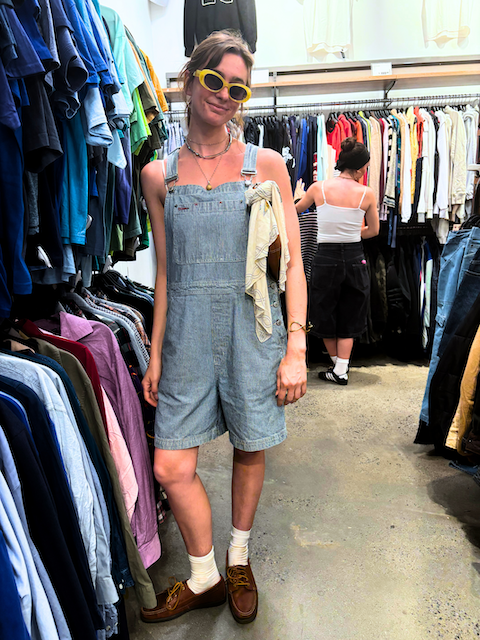 For Cecelia Ganio, originally from St. Petersburg, Florida, fashion came naturally. She always showed up and showed out in her hometown, priding herself on being the best-dressed. Though she enjoyed being the fashionista of her town, she said she felt a certain need to deliver unique looks daily.
Now, after moving to New York for a job at Morphew World, a vintage fashion store, she feels that the pressure is off in her day-to-day life. Sometimes, she might opt for a breezier outfit. Blue and white vintage overalls, a white tank top underneath, and retro oval-shaped mustard yellow sunglasses. On another day, however, she says she could feel completely comfortable in a pink tutu on top of a full ball gown.
“That’s just who I am,” she shrugged.
Byrd felt that the city gave her the same freedom of flexibility that Ganio expressed.
Though she says she wholeheartedly prefers a full-beat makeup look over the clean-girl aesthetic any day, she did acknowledge that she “always felt comforted” no matter what she was wearing. “I can be in ugly gray sweats and a big old jacket and some sneakers and walk into Duane Reade and no one is going to be like, ‘what happened to our fashion icon?’” she said.
All three of them have made a point to incorporate sustainable clothing into their current wardrobes, crediting New York’s bustling thrift culture to the shift. Ganio, who works in vintage fashion, can obtain second-hand, highly sought-after pieces. She mentioned that some of her favorite clothes come from Karl Lagerfeld, especially the ones meant for the runway.
Everything in her closet has been meticulously hand-selected. “I think every piece that I have has a story to me… when you’re so picky about what you’ve put into your closet, you care more about what you have.”
This connection that she has fostered with her clothes also allows her to keep the same pieces for years. She explained that if she doesn’t see herself wearing something in five years, she simply won’t buy it.
Hayes is also focused on pieces that are better for the world at lower prices, pairing sustainability with affordability. She expressed that thrifting in big cities such as New York or Atlanta is exponentially easier than in the suburbs due availability. Her closet is always a work in progress, and she says she would be lying if she claimed she always shops second-hand, but she is making the effort.
She said that thrift stores often have a unique variety. While at NYU, she remembers finding a pair of Stuart Weitzman loafers for $20 when they usually had gone for over $200. “They’re just my size, and I still have them,” she said.
Byrd offered a different perspective, pointing out how thrift stores often don’t offer many plus-sized options. She frequently found herself traveling farther and farther away from the heart of the city, which counteracted the convenience aspect she was hoping for.