
Student-produced news blog
The Spectrum is the online publication of the Urban Journalism Workshop, a career prep program for teens at NYU's Arthur L. Carter Journalism Institute.
Special thanks to the following for their generous support:

Environment Science & Health
‘Bee boxes’ revive a buzzing population
By Keerthisri Senthilkumar
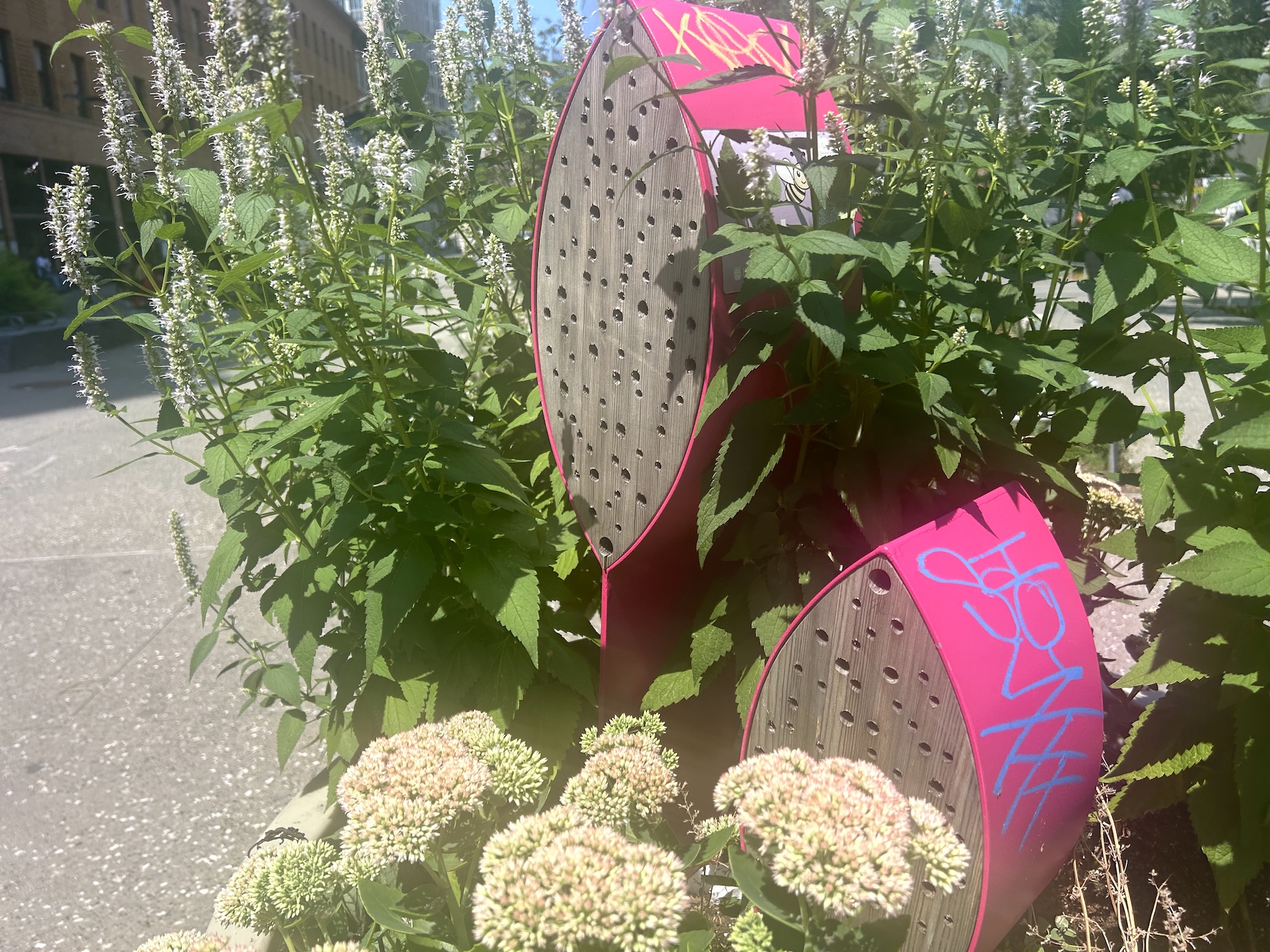
Outside a Brooklyn apartment building, manmade bee hives shoot up from flower pots. In Manhattan’s Cooper Square, they dwell in flower beds. Bees buzz and fly in, out and around.
Through those and other in The Horticultural Society of New York’s network of Borough Bee Boxes, bees can find repose. Over a single season, generally, they nest in those boxes, they procreate, they die.
Bee boxes are an artificial alternative to natural ecosystems destroyed by New York City high-rises and other urban development, providing native bees a safe habitat.
But what’s the point?
“As any city population continues to remove natural habitats … you’re going to have an issue with native bee populations,” said Ken Alaimo, director of horticultural operations for the society, located in Midtown Manhattan.
The 2022 Empire State Native Pollinator survey found that at least 38% and as much 60% of New York’s native pollinators “are at risk because they are rare or declining.” Centuries ago, immigrant colonists brought non-native European honeybees to North America. They competed with local bees for pollen and nesting areas. They transmitted deadly disease. They tanked some of New York’s natural bee biodiversity.
The Horticultural Society of New York “[strives] for a balance between maintaining honey bee populations while also increasing the native bee populations that are naturally decreasing,” Alaimo said.
The Horticultural Society’s Bees Belong in the Borough’ initiative works to prevent monoculturism, where one species dominates an entire area. Footing the whole bill but collaborating with the New York City Department of Transportation, the Horticultural Society brings flora to flowerless streetscapes. The foliage piques bees’ interest and doubles as nourishment.
“If you look in the lower-income areas in our city,” said Sara Hobel, the Horticultural Society’s president and chief executive officer, “there is quite a lack of parkland that … can provide the kind of habitat support that both humans and wildlife need.”
Since its inception, the Bees Belong in the Borough project has grown to 100 sites throughout the city.
By cultivating more plants around the city, the Horticultural Society hopes to “bring back more of the nesting materials and locations for the bees so they can reproduce and create a healthy population in our city.”
The focus, Hobel emphasized, is not only on “improving life for humans but, along the way, improving habitat and life for our important pollinating species.”