
Student-produced news blog
The Spectrum is the online publication of the Urban Journalism Workshop, a career prep program for teens at NYU's Arthur L. Carter Journalism Institute.
Special thanks to the following for their generous support:

Business Community Economics
In Chinatown, displacement continues
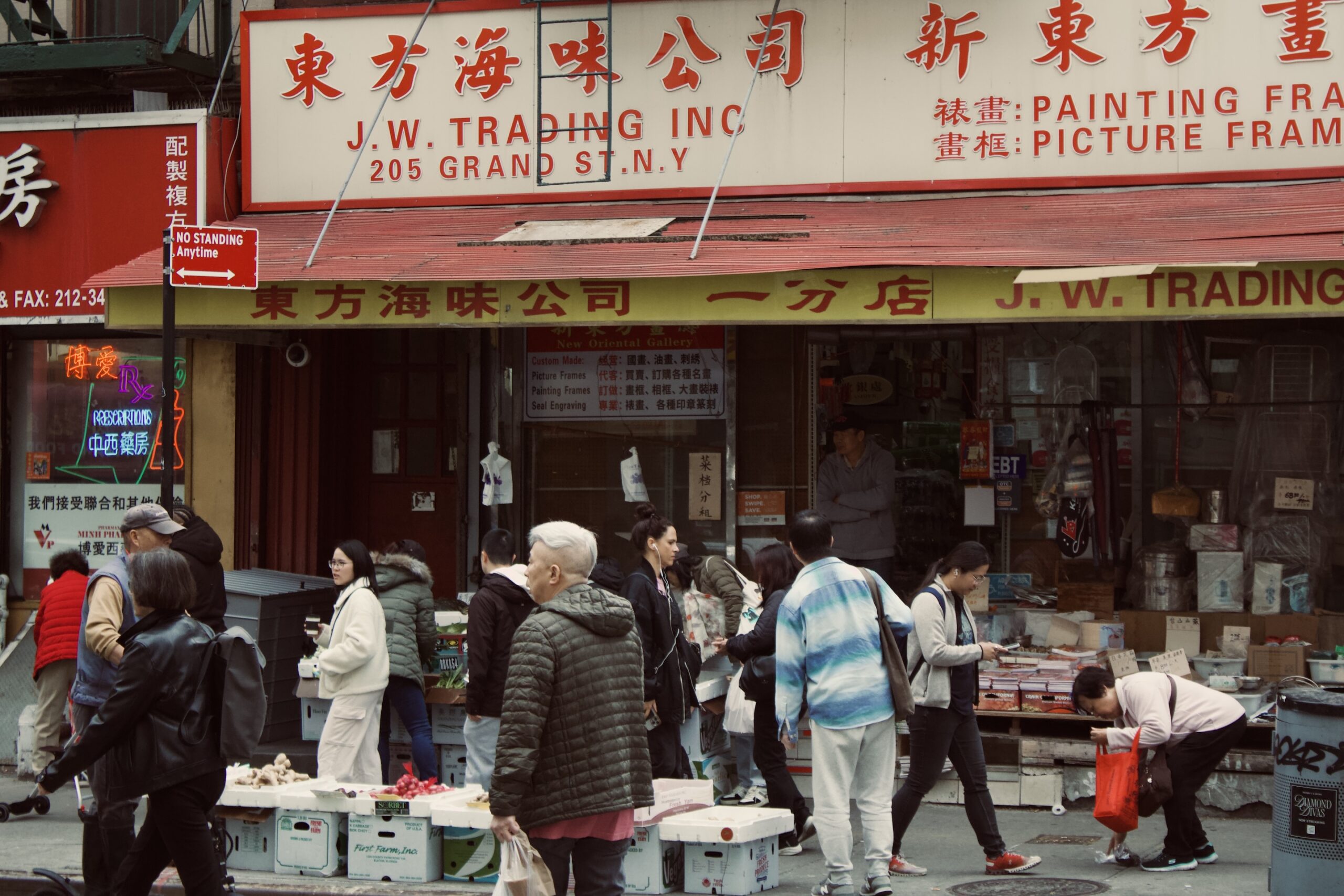
By Kevin Chen
Behind the frosted display, 10 flavors of rolled ice cream and 15 toppings — mango yellow, strawberry red, blueberry purple — line the counters of Minus Celsius. Qiming Li settled into his store on the corner of Grand Street and Allen in 2016, when the average monthly rent in Chinatown was $1,028. Today, Chinatown rent hovers around $4,347, a 323% increase.
“Chinatown is a vital cultural anchor,” said Li, 40, who opened his store the same year he immigrated from China, “but the soaring rents and rising costs of ingredients have heavily squeezed our profit margins, making it a constant challenge to survive.”
Inflation and tariffs as steep as 145% on Chinese-imported goods have affected businesses across Chinatown. Mom-and-pop shops — 98% of which are small or family-owned — are already shutting down, pressured by falling profits, high rents and fluctuating tariffs. According to the New York City Office of the Comptroller, 18% of Chinatown real estate is vacant.
“Housing and living costs have become so high…families can no longer afford to settle here and are being pushed to outer boroughs,” Li said, adding that trendy spots for young, sometimes non-Asian, crowds have sprouted up. Many former Chinatown residents have moved to less expensive neighborhoods outside of Manhattan, including Flushing, Queens.
Between 1990 and 2020, Chinatown’s Asian population has decreased by 24%, according to the Asian American Legal Defense & Education Fund. Between 2000 and 2020, there was an 81.8% increase in the number of businesses in Flushing, which is 67% Asian.
“Chinese immigrants don’t come to this country with suitcases of money,” said activist Karlin Chan, 67, founder of Chinatown Block Watch, “immigrants can’t afford these rents here.”
Chan, whose family moved to New York when he was two, created the group to combat crime and host such events as the Chinatown Lunar New Year dragon dance at Sara Roosevelt Park.
In 2023, across from the park at 199 Chrystie Street, a 14-story condo apartment building opened. The units cost from $1.2 million to $20.5 million. Luxury condos like 199 Chrystie threaten the small businesses of Chinatown, bringing in wealthier residents and causing decreases in less wealthy residents.
Over a decade, there was a 92% increase in the number of Chinatown households with incomes of at least $100,000 a year. The number of households with incomes of $99,000 or less has decreased by 11%, according to an August 2022 report by the New York State Downtown Revitalization Initiative.
Founded in October 2024, Welcome to Chinatown’s Small Business Innovation Hub is one of several Asian-founded groups working to keep longtime residents and businesses in Chinatown. Its co-founders declined to be interviewed by The Spectrum, referring this reporter to its website. It says the group was created in response to the “xenophobic” and “accelerated gentrification” of Chinatown. In 2025, the nonprofit served more than 1,300 small businesses and entrepreneurs in an effort to pass “on cultural and economic wealth to create a foundation for longevity.”
Chinatown is a “community built on the hard work and dreams of immigrant families,” ice cream store owner Li said. “We work together.”