Stopping for a celestial, New York moment
By Sophie Yang
Briefly, Manhattan forgot to be in a hurry.
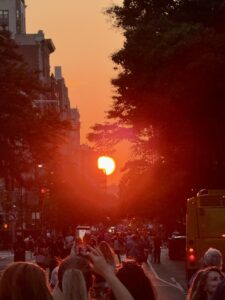
For three fleeting minutes — along some of the city’s busiest east-to-west cross streets — strangers stood still, shoulder to shoulder, their gaze fixed on a sliver of sunset.
“It’s so aesthetically beautiful,” said Noelia Grardy, a Brooklyn College student.
“Compositionally, it’s really beautiful to have it perfectly aligned down the middle,” said Natasha Herman, Gardy’s college classmate and friend.
What had them awestruck was a setting sun’s extraordinary glow — on only four days of the year — over and between the skyscrapers along Manhattan’s 14th, 23rd, 34th, 42nd and 57th streets. Celebrity astrophysicist Neil deGrasse Tyson, who ran the museum’s planetarium, dubbed it Manhattanhenge, after Stonehenge in England. That almost 30-ton, 5,000-year-old astronomical calendar on land was made of sarsen and used in ancient days to track the sun, solstices and farming seasons.
To capture the Manhattan spectacle, onlookers pulled out their cellphones. Photographers adjusted their tripod-mounted cameras to frame the red, blood-orange, amber and gold beams of light reflecting off of windows and permeating the city grid. The event occurs on two days in late May, when only half of the sun hovers above the horizon, and two in early July, when the full solar disk is visible. Manhattan’s street grid is on angle — at a 29-degree tilt from true north — which makes Manhattanhenge possible.
Beyond watching an extraordinary sunset, Manhattanhenge offers the chance to slow down and ponder.
“It’s this crazy, universal experience where we all get to see the sun line up like that. It’s almost like an eclipse,” said Alex McCleary, who was in a crowd of onlookers at WHERE. “What are the chances everything aligns that way? It’s one of those universal coincidences that makes you stop and appreciate it.”
“It’s such a draw,” environmental studies major Herman said, “because seeing the community come together for a shared experience is really special. It’s cool to see people gathered in a space where nature and the city intersect.”
“I could see it,” Gardy said, “becoming an annual tradition, where we all come together once a year. It’s a good way to reconnect. At the very least, it’s a chance to see each other once a year.”
Depending on how wide open the camera lens is, the Manhattanhenge sunset has a bigger or smaller starburst effect, according to Photouno.com.
“That’s why people are so fascinated by it,” Herman said. “People who just like the aesthetics of it or who like photography.”
But for some photographers, capturing the photo is just part of the experience. When the sun disappeared that July day, some of them headed home to select and edit photos and prepare to show them off on social media.
“This is definitely going on my summer 2026 post,” Grady said.
“I am hoping to post it on a dump soon,” said Trey Deandre, a tourist visiting from Texas, about flooding Instagram with a string of his unedited pics.
“I didn’t know until today that the event was happening, until 20 minutes ago. We were just passing by. So, it was pretty cool to photograph it.”
Ahmed Massoud’s cellphone wallpaper is a favorite photo that he snapped during last year’s Manhattanhenge.
“It’s really aesthetically beautiful,” said Brooklyn College student Massoud, who was with Grady and Herman. “Not many people can say they got a photograph like that.”


Commentary Science & Health
Stopping for a celestial, New York moment
By Sophie Yang
Briefly, Manhattan forgot to be in a hurry.
For three fleeting minutes — along some of the city’s busiest east-to-west cross streets — strangers stood still, shoulder to shoulder, their gaze fixed on a sliver of sunset.
“It’s so aesthetically beautiful,” said Noelia Grardy, a Brooklyn College student.
“Compositionally, it’s really beautiful to have it perfectly aligned down the middle,” said Natasha Herman, Gardy’s college classmate and friend.
What had them awestruck was a setting sun’s extraordinary glow — on only four days of the year — over and between the skyscrapers along Manhattan’s 14th, 23rd, 34th, 42nd and 57th streets. Celebrity astrophysicist Neil deGrasse Tyson, who ran the museum’s planetarium, dubbed it Manhattanhenge, after Stonehenge in England. That almost 30-ton, 5,000-year-old astronomical calendar on land was made of sarsen and used in ancient days to track the sun, solstices and farming seasons.
To capture the Manhattan spectacle, onlookers pulled out their cellphones. Photographers adjusted their tripod-mounted cameras to frame the red, blood-orange, amber and gold beams of light reflecting off of windows and permeating the city grid. The event occurs on two days in late May, when only half of the sun hovers above the horizon, and two in early July, when the full solar disk is visible. Manhattan’s street grid is on angle — at a 29-degree tilt from true north — which makes Manhattanhenge possible.
Beyond watching an extraordinary sunset, Manhattanhenge offers the chance to slow down and ponder.
“It’s this crazy, universal experience where we all get to see the sun line up like that. It’s almost like an eclipse,” said Alex McCleary, who was in a crowd of onlookers at WHERE. “What are the chances everything aligns that way? It’s one of those universal coincidences that makes you stop and appreciate it.”
“It’s such a draw,” environmental studies major Herman said, “because seeing the community come together for a shared experience is really special. It’s cool to see people gathered in a space where nature and the city intersect.”
“I could see it,” Gardy said, “becoming an annual tradition, where we all come together once a year. It’s a good way to reconnect. At the very least, it’s a chance to see each other once a year.”
Depending on how wide open the camera lens is, the Manhattanhenge sunset has a bigger or smaller starburst effect, according to Photouno.com.
“That’s why people are so fascinated by it,” Herman said. “People who just like the aesthetics of it or who like photography.”
But for some photographers, capturing the photo is just part of the experience. When the sun disappeared that July day, some of them headed home to select and edit photos and prepare to show them off on social media.
“This is definitely going on my summer 2026 post,” Grady said.
“I am hoping to post it on a dump soon,” said Trey Deandre, a tourist visiting from Texas, about flooding Instagram with a string of his unedited pics.
“I didn’t know until today that the event was happening, until 20 minutes ago. We were just passing by. So, it was pretty cool to photograph it.”
Ahmed Massoud’s cellphone wallpaper is a favorite photo that he snapped during last year’s Manhattanhenge.
“It’s really aesthetically beautiful,” said Brooklyn College student Massoud, who was with Grady and Herman. “Not many people can say they got a photograph like that.”