
Student-produced news blog
The Spectrum is the online publication of the Urban Journalism Workshop, a career prep program for teens at NYU's Arthur L. Carter Journalism Institute.
Special thanks to the following for their generous support:

Arts & Entertainment Gender
Women hiring women in film
By Ellie Kourkoulakos
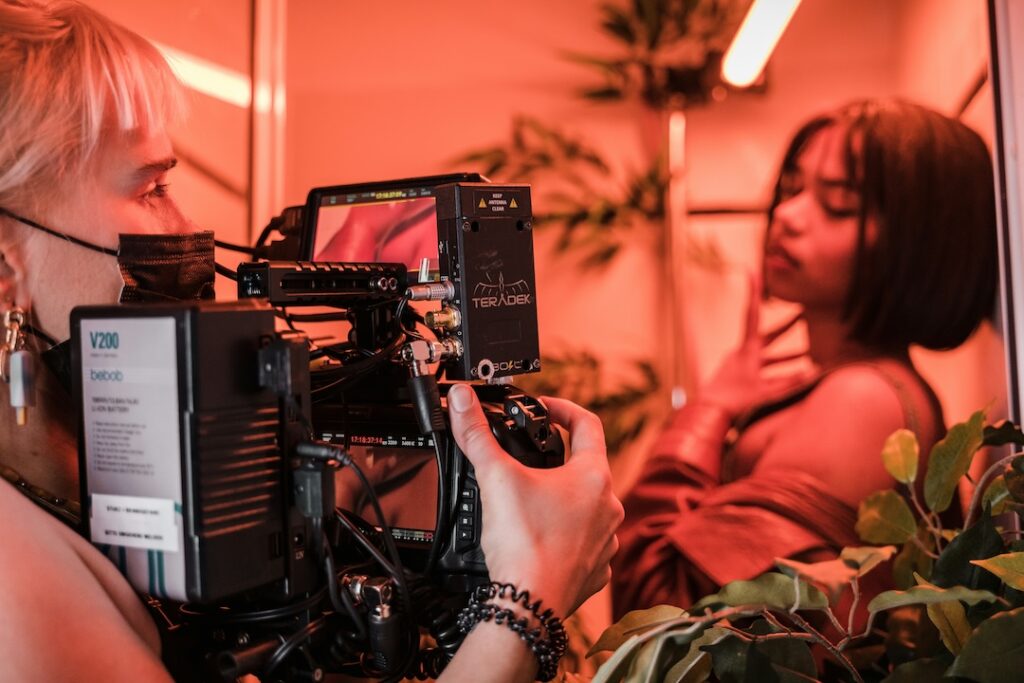
A young man was motioning to passersby to avoid the Washington Square South sidewalk where cameramen were peering through lenses and others on the film crew were assembling equipment they pulled from plastic containers.
The directors’ chairs lined up on the sidewalk would eventually seat Lena Dunham and Natalie Portman, actresses who decided to take charge behind the scenes. Their film, “Good Sex” stars Natalie Portman, Rashida Jones, Meg Ryan, Mark Ruffalo and Tramell Tillman.’
Dunham and Portman are making the kind of take-charge moves that filmmaker and creative director Rachel Myers, who teaches production design at New York University, likes to see.
“We have to hire ourselves to build the world and the change we want to see,” said Myers, of NYU’s Tisch School of the Arts, remembering what a former Black woman boss told her.
That woman was in charge of what Myers described as a diverse film set, those on camera and those working behind the scenes.
Myers has carried those words with her while making her way in filmmaking, an industry where women remain a minority.
“I build my creative teams in terms of putting together a cross-section of people that represent a sort of spectrum of perspectives,” Myers said.
Several studies have shown where women are present and where they are absent in filmmaking.
“Films with at least one woman director employed substantially more women in other key behind-the-scenes roles than films with exclusively male directors,” according to San Diego State University’s 27th annual “The Celluloid Ceiling” report.
According to UCLA’s Hollywood Diversity Report 2025, in streaming film, 28% of directors, 37% of writers and 43.8% of total actors were women. In comparison to their report from 2020, 15.1% of directors, 17.4% of writers and 40.2% of actors were women. Though there has been a slight increase over the course of five years, men continue to dominate the industry.
It remains difficult for women to rise to the top of the film industry and other media due to “unequal opportunities, inaccurate images, and unfair representations of women,” Julie Burton, president and CEO of the Women’s Media Center, wrote in an email.
Her center’s Status of Women in U.S. Media reports have aggregated analyses, including UCLA’s assessment of diversity by gender, race and disability/ability in Hollywood.
According to USC Annenberg Inclusion Initiative, for the 2025 Academy Awards, women only accounted for 27% of nominees and men accounted for 73%.
Yet, women have been influential during some of film’s most important moments in history, even if they’ve often appeared to be absent.
During a recent documentary film series at the Tisch school, filmmaker Kent Jones, director of “Hitchcock/Truffaut,” said Alfred Hitchcock “consulted his wife on every movie he ever made.”
Jones told this reporter that Alma Reville, Hitchcock’s wife, even wrote and edited some of his movies, but she wasn’t given credit.
Famous for such movies as “Psycho” and “The Birds,” Hitchcock abided by his wife’s comments and used her perspectives in the writing and editing aspects of his productions, Jones told this reporter, after discussing his documentary with an audience at the screening.