
Student-produced news blog
The Spectrum is the online publication of the Urban Journalism Workshop, a career prep program for teens at NYU's Arthur L. Carter Journalism Institute.
Special thanks to the following for their generous support:

Arts & Entertainment History Politics
An exhibit on flag-burning artists of 1970
By Nayla Nernekian
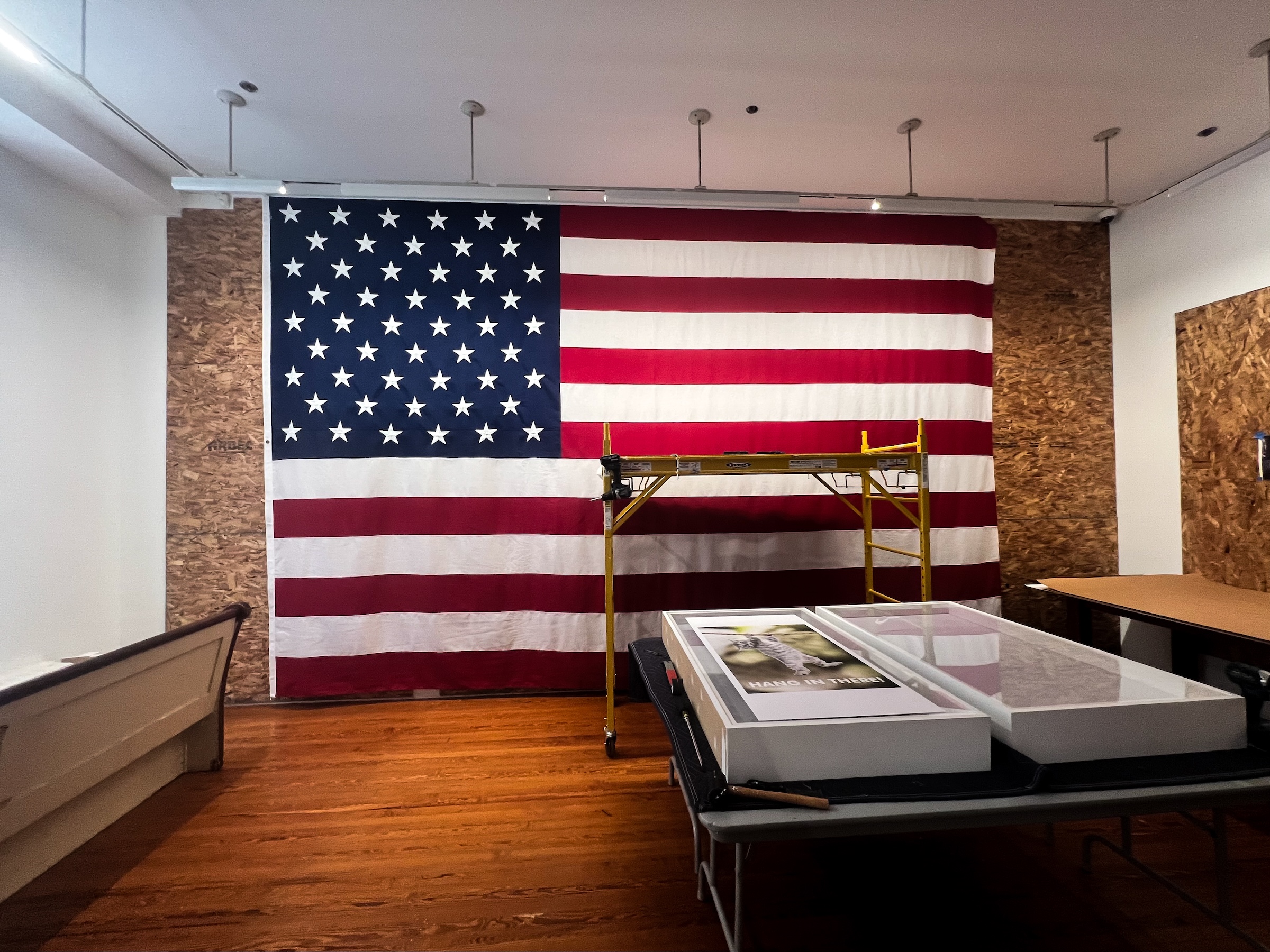
The first items viewable to those entering 80WSE Gallery on Sept. 9 will be a wall-sized U.S. flag, photos of Christian crosses and a plywood table from the church that hosted “The People’s Flag Show,” an open-call art show protesting war, racism, patriarchy and government surveillance in 1970.
If those visitors follow the curated order of that upcoming exhibit, “Incendiaries: The People’s Flag Show 1970,” the next things they’ll peruse are photographs of the art and artists. They’ll watch and listen to footage of speeches from members of the Black Panthers and the Gay Liberation Front, quilter Faith Ringgold, and feminists Kate Millett and Lil Picard. The upcoming exhibit revisits the 56-year-old show, the political climate that spurred it and the activists arrested for burning the U.S. flag at Judson Memorial Church.
“They were together, they were unified and they had that moment: ‘If you show up for my thing, I’ll show up for your thing.’ We’ve lost a bit of that solidarity,” gallery manager Jon Huron said. “It’d be nice to point towards something and be like, ‘Hey, look. It’s not impossible.’”
“We’re always trying to figure out how we can respond to the moment,” said Howie Chen, curator of 80WSE.
Chen and Huron co-curated the upcoming show, which attempts to connect the past and present. “We struggle with the idea of looking back into history and trying to learn any lessons from it,” Chen said.
The exhibit revisits works by over 150 artists opposing the Vietnam War and laws against desecrating the U.S. flag that, almost two decades later, the U.S. Supreme Court struck down.
Ringgold, abstract artist and poet Jean Toche and curator Jon Hendricks — the “Judson Three — were among those arrested for burning the flag. Taped interviews with them will be part of “Incendiaries.” News coverage of the protest, negative letters to Judson from conservative Baptists and a copy of a legal brief from the federal lawsuit over the arrests will also be included.
The Judson Three, Chen said, were “a touchstone in art history,” setting precedent for artistic freedom of expression. They also demonstrated uneven enforcement of the law: an entertainer could wear a flag as a costume without consequence, but flag-burning was treated as desecration.
The co-curators find the examination of history important.
“We can use the past to think about the present and make the past feel really alive because a lot of the questions have not changed. It’s just gotten more complex,” Chen said. “We’re talking about how art and politics interact and how they did interact in the past.”
To him, Americans today grapple with the same inequalities and conflicts protested in The People’s Flag Show.
“How else are you gonna celebrate America’s 250th birthday?” Huron said.
Using materials sourced from New York University’s Fales Library, Chen and Huron organized “Incendiaries” across 80WSE’s five galleries. The final room has footage of two significant performances from the original show. On the right will be Yvonne Rainer’s “Trio A With Flags” dance; on the left will be Toche and Hendricks, who formed the Guerrilla Art Action Group, burning a flag Ringgold made.
Viewers can watch the recordings while sitting on one of Judson’s pews, also made of plywood.
Before The People’s Flag Show, Judson Memorial Church was already a hub for activism and outreach, providing support for addiction treatment, abortion counseling, runaway youth counseling and civil rights and anti-war organizing. The congregation, Huron said, “ran against the grain of ‘normal [conservative] Baptists.’”
Judson also did not display an oversized cross, as many churches do, since the pastor, the Rev. Howard Moody, wanted to extend Judson’s outreach beyond Christians.
The curators’ research hasn’t uncovered the names of all 150 artists. The curators’ priority is not identifying who, in particular, participated or on the celebrities among them. “Focusing on the most famous artists in the show takes away from collective action,” Chen said.
“Incendiaries’” curators believe audiences will understand the meaning behind the exhibit. “It’s indexing history … ” Huron said.